Tinnitrol Review: Sublingual Tinnitus & Hearing Support Spray (2026)
 By Sophie Callahan · Updated October 3, 2026
Key Takeaways
Tinnitrol is a sublingual spray marketed for tinnitus and hearing support, containing six ingredients that target neurotransmitter pathways, cochlear circulation, and neuroprotection. The formula's most scientifically grounded ingredient is GABA — reduced GABA levels in the auditory cortex are consistently documented in tinnitus patients. The sublingual delivery format is a genuine differentiator from capsule-based competitors. However, every ingredient dose is undisclosed, no Supplement Facts panel is publicly available, and the $179 single-bottle price point is among the highest in the category. The 90-day money-back guarantee is the buyer's primary safety net.
- Sublingual spray targeting tinnitus through neurotransmitter and vascular pathways. Tinnitrol takes a different approach from most hearing supplements by using a sublingual spray rather than capsules, and by focusing on neurotransmitter balance (GABA, dopamine precursors, acetylcholine support) and cochlear blood flow (L-Arginine) rather than the antioxidant-heavy formulas common in the category.
- GABA's role in tinnitus has genuine published evidence. A 2022 MR spectroscopy study found significantly lower GABA levels in the auditory cortex of tinnitus patients. An earlier clinical report showed GABAergic therapy controlled tinnitus in 90% of 21 patients. A 2025 proof-of-mechanism trial with the GABA modulator brexanolone further supports the pathway's relevance.
- All six ingredient doses are undisclosed — no Supplement Facts panel is publicly available. Unlike formulas that at least disclose their headline ingredients' amounts, Tinnitrol publishes no individual doses for any compound, and the product page does not display a standard Supplement Facts panel. This makes it impossible to compare what the spray delivers against the doses used in published research.
- 90-day money-back guarantee with no subscription. At $179 per bottle for a single order (with multi-bottle discounts available for the 6-bottle package), the guarantee window covers a full 90-day evaluation period. No autoship or recurring charges — the guarantee is the buyer's primary protection given the undisclosed dosing.
Tinnitus — the perception of ringing, buzzing, or hissing in the ears without an external sound source — affects an estimated 10–15% of the adult population, with roughly one in four sufferers describing it as significantly disruptive to daily life. Despite decades of research, there is no FDA-approved pharmaceutical specifically for tinnitus, which has created a large and growing market for supplements that promise relief through natural compounds. Most formulas in this space take an antioxidant-first approach — zinc, magnesium, B vitamins, ginkgo biloba — targeting oxidative damage to the cochlea. Tinnitrol charts a different course entirely: a sublingual spray built around neurotransmitter modulation and vascular support, anchored by GABA, dopamine and acetylcholine precursors, and the nitric oxide pathway. The question is whether this mechanistically distinct approach delivers meaningful amounts of its active ingredients in a format that can reach the relevant targets.
What Is Tinnitrol, Mechanically?
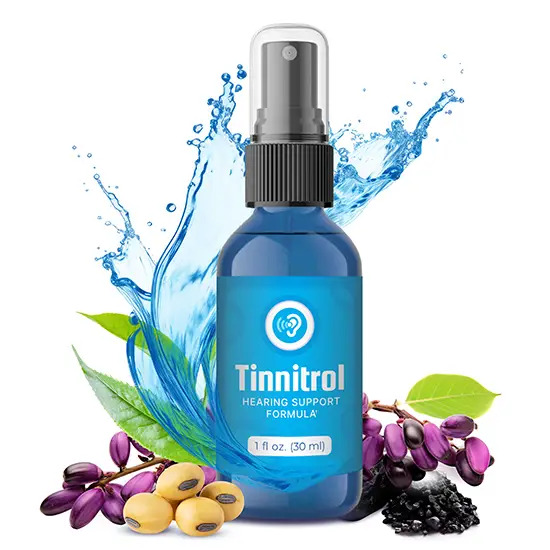
Tinnitrol is a dietary supplement sold as a sublingual spray — a liquid formula applied under the tongue rather than swallowed as a capsule or tablet. The recommended usage is 2 full sprays in the morning and 4 full sprays before bedtime. The formula contains six named ingredients: Alpha-GPC (a choline compound that supports acetylcholine synthesis), GABA (the primary inhibitory neurotransmitter), L-Dopa Bean (Mucuna pruriens extract, a natural source of L-DOPA/dopamine precursor), Moomiyo (Shilajit, a mineral-rich resin with adaptogenic properties), L-Arginine (a precursor to nitric oxide, which regulates blood flow including cochlear microcirculation), and L-Tyrosine (a precursor to dopamine and norepinephrine). No individual ingredient doses are disclosed, and no Supplement Facts panel is publicly displayed on the product page. The product is described as 'assembled in the United States' and sold through BuyGoods (a Delaware corporation). Creator Mike Rubens is listed as the product's developer, with no disclosed medical or scientific credentials.
Who Tinnitrol Is For
Tinnitrol positions itself as a neurotransmitter-focused approach to tinnitus support — rather than loading up on antioxidant vitamins and minerals, the formula targets the brain's signaling chemistry and the inner ear's blood supply. The central premise is that tinnitus involves aberrant neural signaling in the auditory cortex, and that modulating key neurotransmitters (particularly GABA and dopamine) while supporting cochlear blood flow may help the brain process auditory signals more normally.
This is not an unreasonable theoretical framework. Published research has consistently shown that tinnitus patients have lower GABA concentrations in the auditory cortex compared to controls, and that GABAergic interventions can reduce tinnitus perception in clinical settings. The sublingual delivery format is a legitimate pharmacological choice — it bypasses first-pass metabolism in the liver and may improve bioavailability for certain compounds compared to oral capsules. The practical question, as with any supplement that withholds its dosing data, is whether the formula delivers enough of each ingredient to meaningfully engage the pathways it targets.
Tinnitrol
Sublingual spray with Alpha-GPC, GABA, L-Dopa Bean, Moomiyo, L-Arginine, and L-Tyrosine. 6 sprays daily. All doses undisclosed.
$179 per bottle (single order, includes 3 free digital bonuses). Multi-bottle discounts available for the 6-bottle package with free shipping. Prices confirmed from the official page in September 2026.
90-day money-back guarantee on all orders. No autoship or recurring charges. No-questions-asked refund policy within 90 days of purchase.
This offer is temporarily unavailable — showing our current alternative pick.Living With It
The daily routine involves sublingual sprays — 2 in the morning, 4 before bedtime — held under the tongue for 30–60 seconds before swallowing. This is a fundamentally different user experience from swallowing capsules: the spray format is convenient and portable, and sublingual absorption delivers compounds directly into the bloodstream through the mucous membranes under the tongue, bypassing the digestive tract. For people who have difficulty swallowing pills, this is a genuine practical advantage. The morning/evening split follows the pattern of GABAergic compounds that influence both daytime focus and nighttime relaxation — a dosing schedule that makes pharmacological sense for ingredients like GABA and L-Tyrosine, which have complementary roles in the excitatory/inhibitory neurotransmitter balance. Because no individual doses are disclosed, buyers who take other supplements containing GABA, L-Arginine, L-Tyrosine, or choline compounds cannot calculate their total daily intake. The spray format also means the product is not suitable for travelers who need TSA-compliant liquid limits in mind. If you take medications that affect neurotransmitter levels — SSRIs, MAOIs, levodopa for Parkinson's, or blood pressure medications — consult your physician before adding any supplement containing GABA, L-DOPA, or L-Arginine, as interactions are possible.
What Works in Its Favor
- The only tinnitus formula built around the GABA-deficit pathway. Tinnitus research has consistently identified reduced GABA levels in the auditory cortex as a key neurochemical correlate. A 2022 2D-JPRESS MR spectroscopy study confirmed significantly lower GABA and glutamate in the auditory cortex of tinnitus patients. Including GABA in a tinnitus formula directly addresses the most well-documented neurochemical imbalance associated with the condition.
- Sublingual delivery bypasses first-pass metabolism. Sublingual absorption delivers compounds directly into the bloodstream through the oral mucosa, avoiding degradation in the gastrointestinal tract and liver. For compounds like GABA — which has debated oral bioavailability and limited blood-brain barrier permeability when taken orally — sublingual delivery is a pharmacologically rational format choice that may meaningfully improve how much of the active ingredient reaches systemic circulation.
- L-Arginine targets cochlear microcirculation through the nitric oxide pathway. Published research shows that nitric oxide plays a role in regulating cochlear blood flow. A study by Nakashima et al. demonstrated that L-arginine infusion partially reversed cochlear blood flow decreases caused by NOS inhibition. A 2021 study found that nitric oxide protects against noise-induced hearing loss through metabolic reprogramming in cochlear hair cells.
- Neurotransmitter precursors cover multiple signaling pathways. Alpha-GPC supports acetylcholine synthesis (the cholinergic pathway), L-Dopa Bean provides L-DOPA for dopamine production (the dopaminergic pathway), and L-Tyrosine serves as a precursor for both dopamine and norepinephrine (the catecholaminergic pathway). This multi-pathway neurotransmitter approach mirrors the complexity of tinnitus neuroscience, where no single neurotransmitter system fully explains the condition.
- 90-day money-back guarantee with no subscription model. The guarantee window is long enough for a meaningful evaluation period — tinnitus is a condition where supplement effects, if any, typically require weeks to months of consistent use. No autoship, no recurring charges, and the no-questions-asked refund policy reduces the financial risk of the $179 entry price.
- Moomiyo (Shilajit) adds adaptogenic and neuroprotective properties. A 2012 review documented shilajit's procognitive activity, with fulvic acid — its primary active compound — shown to block tau self-aggregation and support cognitive function. A safety review confirmed its tolerability in human studies.
Key Specs
- Format
- Sublingual spray (liquid, applied under the tongue)
- Serving size
- 2 sprays AM + 4 sprays PM (6 sprays daily total)
- Ingredient count
- 6 named ingredients (neurotransmitter precursors, amino acids, adaptogen)
- Dose disclosure
- Undisclosed — no Supplement Facts panel publicly available
- Manufacturing
- Assembled in the United States; no GMP or FDA-registered facility claim
- Guarantee
- 90-day money-back guarantee, non-subscription purchase
Performance
Evaluating Tinnitrol's performance requires assessing each ingredient's relevance to tinnitus specifically — not just general brain health — and then confronting the dose transparency question.
GABA (Gamma-Aminobutyric Acid). This is the formula's strongest mechanistic pillar. A 2022 2D-JPRESS MR spectroscopy study by Deng et al. found significantly lower GABA concentration (medium effect size) in the left auditory cortex of tinnitus patients compared to controls. An earlier clinical report by Shulman & Goldstein (2003) documented tinnitus control lasting from 4–6 weeks to 3 years in 19 of 21 patients (90%) using GABA-targeted benzodiazepine therapy. A 2025 proof-of-mechanism trial with brexanolone (a positive allosteric modulator of GABAA receptors) further supports this pathway. The challenge: oral GABA's ability to cross the blood-brain barrier is debated. Sublingual delivery may partially address this limitation, but whether the dose in Tinnitrol reaches a meaningful level is unknown.
L-Arginine. The nitric oxide connection to cochlear health is well-established. Nakashima et al. (2003) demonstrated that L-arginine infusion reversed cochlear blood flow decreases caused by NOS inhibitors. A 2021 study by Han et al. found nitric oxide protects against noise-induced hearing loss through glucose metabolic reprogramming in cochlear hair cells. However, the evidence is mixed: a 2025 review found that 58% of studies reported NO caused or worsened hearing loss, while 26% found beneficial effects — making the net direction dose- and context-dependent. Clinical studies using L-arginine for vascular effects typically employ doses of 3–6 g/day orally, a quantity that would be difficult to deliver via spray.
Alpha-GPC. A well-studied cholinergic compound that supports acetylcholine synthesis. No published studies directly link Alpha-GPC supplementation to tinnitus outcomes. Its inclusion appears based on the broader rationale that cholinergic neurotransmission is involved in auditory processing — a plausible but indirect connection. Clinical cognitive studies typically use 400–1,200 mg/day.
L-Dopa Bean (Mucuna pruriens). Contains 4–6% L-DOPA, a direct precursor to dopamine. A 2008 study by Manyam et al. confirmed neuroprotective effects in a Parkinson's disease model. Dopamine is involved in auditory gating — the brain's ability to filter which sounds reach conscious awareness — which has theoretical relevance to tinnitus. However, no published studies have tested Mucuna pruriens specifically for tinnitus outcomes. Clinical studies in Parkinson's use doses of 15–30 g/day of seed powder (delivering 500–1,000 mg of L-DOPA).
L-Tyrosine. A catecholamine precursor that supports dopamine and norepinephrine synthesis. A 2015 review by Jongkees et al. evaluated tyrosine supplementation in clinical and healthy populations under stress or cognitive demands, finding benefits most clearly under conditions of depleted neurotransmitter function. No direct tinnitus evidence. Clinical doses are typically 100–150 mg/kg body weight (7–10 g for a 70 kg adult).
Moomiyo (Shilajit). A mineral-rich resin with documented procognitive activity mediated primarily through fulvic acid. No direct tinnitus evidence. Doses in published studies range from 200–500 mg/day of purified extract.
The structural assessment. Of the six ingredients, GABA has direct tinnitus-relevant evidence at the neurochemical level, and L-Arginine has cochlear blood flow evidence — though with mixed directionality. The remaining four ingredients (Alpha-GPC, L-Dopa Bean, Moomiyo, L-Tyrosine) have general neuroprotective or neurotransmitter-support evidence but no published studies specifically testing them for tinnitus outcomes. The sublingual delivery format is a legitimate pharmacological advantage for bioavailability, but it also limits the total volume of active compounds that can be delivered per spray compared to capsules or powders.
What the Sales Page Gets Right — and What It Doesn't
The fundamental premise — that tinnitus involves neurotransmitter imbalances in the auditory cortex — is well-supported by published research. GABA's role in tinnitus is documented across multiple studies, including a 2022 MR spectroscopy study and a 2025 proof-of-mechanism trial with a GABAA receptor modulator. The nitric oxide/cochlear blood flow connection targeted by L-Arginine has published evidence showing that NO participates in cochlear blood flow regulation and can protect hair cells. The sublingual delivery format is a pharmacologically sound approach for improving bioavailability of certain compounds. The choice to target neurotransmitter pathways rather than the antioxidant approach used by most competitors reflects genuine mechanistic reasoning — the six ingredients map to acetylcholine (Alpha-GPC), GABA (direct), dopamine (L-Dopa Bean, L-Tyrosine), norepinephrine (L-Tyrosine), and nitric oxide (L-Arginine) pathways. The 90-day guarantee and absence of autoship reduce financial risk.
The copy 'Don't just manage the noise — SILENCE IT!' is aggressive marketing that overpromises relative to what any supplement can verifiably deliver for tinnitus. No supplement has FDA approval for tinnitus, and the vendor's own disclaimer acknowledges this. Creator Mike Rubens has no disclosed medical, nutritional, or scientific credentials. No Supplement Facts panel is publicly available — the absence of dose data is the most significant transparency limitation, as it makes independent verification impossible. The studies referenced on the sales page are attributed to researchers and years but provide no direct links for verification. Four of the six ingredients (Alpha-GPC, L-Dopa Bean, Moomiyo, L-Tyrosine) have no published tinnitus-specific studies — their inclusion is based on general neurotransmitter and neuroprotection rationale, not demonstrated tinnitus outcomes. The clinical doses for most of these compounds (L-Arginine at 3–6 g/day, L-Tyrosine at 7–10 g/day, Alpha-GPC at 400–1,200 mg/day) are in the multi-gram range, which would be extremely challenging to deliver in a liquid spray format. The manufacturing claim is limited to 'assembled in the United States' — there is no mention of GMP certification, FDA-registered facility, or third-party testing.
Verdict
Tinnitrol earns a narrowly qualified recommendation for buyers who specifically want to explore the neurotransmitter-modulation approach to tinnitus support and are comfortable letting the 90-day guarantee serve as their evaluation period. The formula's strongest asset is its mechanistic logic: GABA's role in tinnitus is genuinely well-documented in the neuroscience literature, the sublingual delivery format is a pharmacologically rational choice, and the multi-pathway neurotransmitter approach (cholinergic, GABAergic, dopaminergic, nitric oxide) reflects the complexity of tinnitus as a neurological condition rather than oversimplifying it.
What buyers should weigh carefully is the transparency gap. Every ingredient dose is undisclosed, no Supplement Facts panel is publicly available, the creator has no disclosed credentials, and the manufacturing claims are minimal. The $179 single-bottle price point is premium territory for a formula where the buyer cannot independently verify whether any ingredient reaches its clinically studied range. Four of the six ingredients lack direct tinnitus evidence — they are general neurotransmitter and neuroprotection compounds included on theoretical grounds.
For buyers drawn to the GABA-pathway approach and the convenience of a sublingual spray, the 6-bottle bundle with free shipping offers the most cost-effective entry point for a full evaluation. The 90-day guarantee means you can commit to a genuine trial period without irreversible financial risk. Go in understanding that the mechanistic rationale is sound but the dose verification is absent — and that the guarantee is what bridges that gap.
This review reflects our independent editorial analysis of the manufacturer's published label and the peer-reviewed literature — see our Editorial Policy and How We Evaluate. You can also view our Tinnitrol Overview for a fast product snapshot. NutrasInsights may earn a commission from qualifying purchases; see our Affiliate Disclosure.
Frequently Asked Questions
What ingredients does Tinnitrol contain?
Tinnitrol contains six named ingredients: Alpha-GPC (a choline compound supporting acetylcholine synthesis), GABA (the primary inhibitory neurotransmitter), L-Dopa Bean (Mucuna pruriens, a natural source of L-DOPA/dopamine precursor), Moomiyo (Shilajit, a mineral-rich adaptogenic resin), L-Arginine (a nitric oxide precursor that may support cochlear blood flow), and L-Tyrosine (a precursor to dopamine and norepinephrine). All individual ingredient doses are undisclosed — no Supplement Facts panel is publicly available on the product page.
How do you take Tinnitrol?
Tinnitrol is a sublingual spray — you apply it under the tongue and hold for 30–60 seconds before swallowing. The recommended usage is 2 full sprays in the morning and 4 full sprays before bedtime (6 sprays total daily). The sublingual delivery format bypasses the digestive system, potentially improving absorption of the active compounds compared to capsules. If you take medications affecting neurotransmitter levels (SSRIs, MAOIs, levodopa, or blood pressure medications), consult your physician before starting.
Does Tinnitrol disclose how much of each ingredient is in the formula?
No. Tinnitrol does not publicly display a Supplement Facts panel showing individual ingredient doses. This means buyers cannot independently verify whether any specific ingredient — such as GABA or L-Arginine — is present at the dose levels used in published clinical studies. The absence of dose disclosure is the formula's most significant transparency limitation.
What is Tinnitrol's refund policy?
Tinnitrol offers a 90-day, no-questions-asked money-back guarantee on all orders. There is no autoship or recurring subscription — each purchase is a one-time charge. To request a refund, contact customer service within 90 days of purchase. BuyGoods (a Delaware corporation) is the retailer of record and handles all transactions and refund processing.
Ready to try Tinnitrol?
See current pricing, bundle deals, and availability on the official page.
Sophie is a staff editor at NutrasInsights covering Cognitive Health supplements. She checks label doses against the published research before any product earns a recommendation.